
Allegan County Obituary Records
Allegan County obituary and death records go back to 1867, covering communities along the Lake Michigan shoreline and the farming towns inland. You can search these records through the county clerk, the Allegan District Library genealogy collection, and several online sources to find death notices, burial details, and family history tied to this part of southwest Michigan.
Allegan County Overview
Allegan County Clerk Records
The Allegan County Clerk is the primary office for death records in the county. The clerk holds death certificates and vital records filed since 1867. Staff can search records by name or date and issue certified copies. The office is in the city of Allegan on Chestnut Street. This is your best starting point for an official death certificate or for confirming a date of death.
Death certificates are the main record type issued here. They show the full name of the deceased, the date and place of death, the cause of death, and often the names of survivors. For genealogy work, these details are hard to find anywhere else. The clerk also holds older vital records that predate state-level filing, which can be useful for tracing family lines that go back into the late 1800s. Records from this era reflect the early Dutch immigrant communities that settled much of this part of southwest Michigan.
The Michigan Department of Health and Human Services holds statewide death records. For deaths recorded at the state level, you can call 517-335-8666 or order through VitalChek. The state charges $34 for the first certified copy and $16 for each extra copy ordered at the same time. The county clerk fee is approximately $10 for the first copy.
| Office | Allegan County Clerk |
|---|---|
| Address |
113 Chestnut St. Allegan, MI 49010 |
| Phone | 269-673-0450 |
| Hours | Monday through Friday, 8:00 AM to 5:00 PM |
| Website | allegancounty.org |
Search Allegan County Death Records Online
The Allegan County MIGenWeb site is a key free resource for obituary research. Volunteers have digitized and indexed death records, obituary clippings, and cemetery transcriptions for many communities in the county. It is a good first stop before you contact the clerk or drive to the library.
The MIGenWeb project indexes records contributed by local researchers and genealogists over many years. You can find full obituary text for some individuals, plus burial locations and cemetery listings. The site also links to records from smaller rural townships that might not appear in other databases. Coverage is uneven across years and towns, but for Allegan County the volunteer database is one of the better-indexed county collections in Michigan.
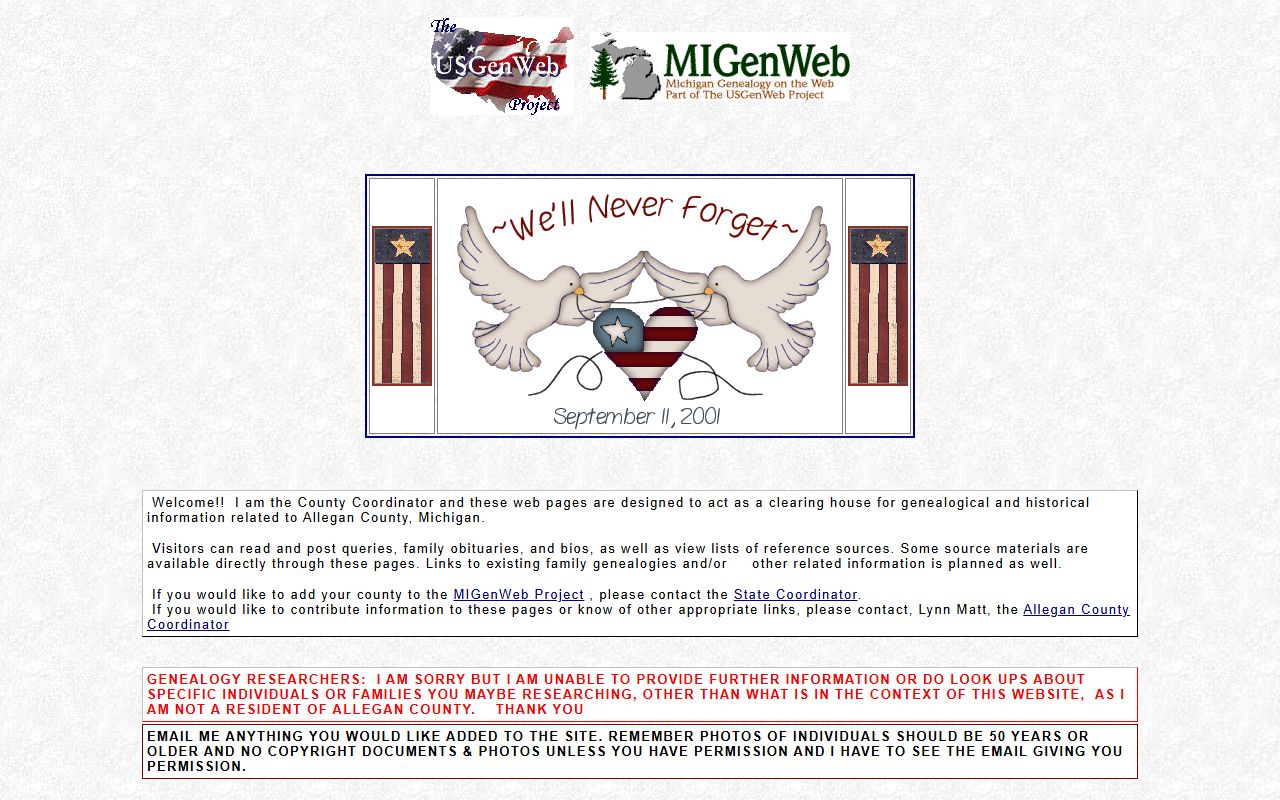
The Allegan County MIGenWeb site at allegan.migenweb.org hosts digitized obituaries, cemetery transcriptions, and death record indexes contributed by local genealogists.
Michiganology is another strong option. The Michigan death records guide at Michiganology explains what records are available and how to access them. The GenDIS database indexes Michigan death records and can be searched by name. It covers a range of years and is free to use. For Allegan County, these records can help you identify the right year and confirm spelling of a name before ordering a certificate.
FamilySearch also has a significant collection. The Allegan County Michigan Genealogy guide on FamilySearch lists what records exist and where to find them. FamilySearch has indexed some Michigan death records and holds microfilm copies of older county records. The broader Michigan Genealogy page gives statewide context for understanding what gaps may exist in the record set.
Note: Online indexes for Allegan County obituaries are strongest for deaths recorded after 1900. Pre-1900 records may require a direct visit to the clerk or library.
Allegan District Library Genealogy Collection
The Allegan District Library at 331 Hubbard St. in Allegan has a genealogy department with local history materials that are not available anywhere else. This includes bound newspaper files, obituary clipping collections, and local history books. The library holds copies of the Allegan Gazette going back many decades. The Gazette published obituaries and death notices for residents across the county, and the library's collection makes these searchable.
The genealogy department is open Tuesday through Thursday only. Plan your visit on those days. Staff can help you use the newspaper index and point you toward the right reference materials. The collection includes materials that document Dutch immigrant families who settled the western part of the county in the mid-1800s. Many of these families lived in townships near Holland and along the Lake Michigan shore. Their records appear in both English and Dutch-language sources, and the library holds some of these original documents.
The library website at alleganlibrary.org has more information on services and hours. Call ahead before visiting to confirm the genealogy room is staffed, since hours can shift. The library does not charge a fee for in-person research, though copies cost a small amount per page.
Note: The genealogy department at Allegan District Library is open Tuesday through Thursday only. Check hours before you make a trip.
Allegan County Cemetery Records
Cemetery records are one of the most useful sources for death and obituary research in Allegan County. Many rural cemeteries in the county have been read and transcribed by volunteers. The Allegan County cemetery listings on MIGenWeb index burial locations by cemetery name and include transcriptions of headstone inscriptions. These records often include birth year, death year, and family relationships carved into the stone.
Allegan County has dozens of small township cemeteries spread across its rural landscape. Many of these date to the mid-1800s when Dutch and other European settlers first moved into the region. Stones in some older cemeteries carry Dutch names and occasionally Dutch-language inscriptions. If you are tracing a family with Dutch roots in the Holland or Saugatuck area, the cemetery transcriptions can help you find burial sites for people who may not appear in newspaper obituaries.
Lake Michigan shoreline communities like Saugatuck, Douglas, and Glenn have their own burial grounds. Some of these smaller cemeteries have been transcribed and are listed in the MIGenWeb database. Others may not yet be indexed. For unlisted cemeteries, the county clerk or local historical society can often point you toward the right location.
Michigan State Death Record Resources
State-level resources supplement what you find at the county level. The Library of Michigan holds historical newspaper collections and genealogy records for the whole state. Their Michigan newspaper collection includes papers from Allegan County. The Archives of Michigan holds older vital records, census materials, and county-level records that have been transferred from local offices to state custody.
Under Michigan Compiled Law 333.2882, death records in Michigan are restricted for 25 years from the date of death. After that period, they become available to the public. This rule applies statewide, including Allegan County. If the death you are researching occurred within the past 25 years, you may need to show that you are an immediate family member or have a legal reason for the request.
For older records, access is generally open. Deaths from the 1800s and early 1900s are fully available through the clerk, the library, and online indexes. The state keeps an index of all deaths registered in Michigan since statewide registration began, and Michiganology's GenDIS database is built from that index. These tools work well together for Allegan County research when used alongside the local resources listed above.
Nearby Counties
These counties share borders with Allegan County. If the person you are researching lived near a county line, records may appear in an adjacent county's files instead.